Chap 9.
상관분석과 회귀분석
9.2 Correlation
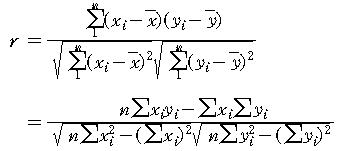
- Def. The sample correlation coefficient for the n pairs
(x_1, y_1), ..., (x_n, y_n) is
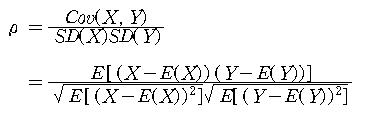
- The population correlation coefficient \rho is a parameter
or population characteristic, so we can use the sample correlation
coefficient to make various inferences about \rho, In particular, r is
a point estimate for \rho, and the corresponding estimator is
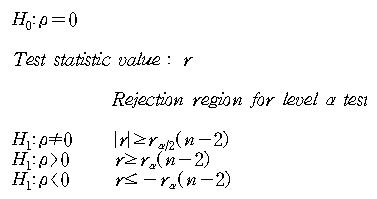
- Procedure for Testing H_0 : \rhp=0
9.3 Simple Linear Regression Analysis
- There exist parameters \alpha, \beta, and \sigma^2 such that for any
fixed value of the independent variable x, the dependent variable is related
to x through the model equation

The quality \epsilon in the model equation is a random variable, assumed to be
normally distributed with E(\epsilon)=0 and V(\epsilon)=\sigma^2.
- More generally the variable whose value is fixed by the experimeter will
be denoted by x and will be called the independent variable.
- For fixed x the second variable will be random; we denote this random
variable and its observed value by Y and y, respectively, and refer to it as
the dependent variable.
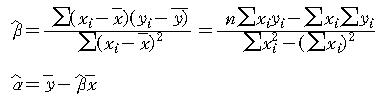
- The least squares estimates of the coefficients \alpha and \beta
of the regression line are
- The ith predicted value, denoted by \hat y_i, is \hat y_i = \hat \alpha + \hat \beta x_i(i=1,...,n), and the ith residual is y_i - \hat y_i.
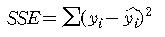
- The error sum of squares, denoted by SSE,
and the estimate of \sigma^2 is
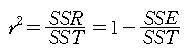
- The coefficient of determination denoted by \rho^2, is given by

- The total sum of squares
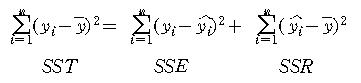
- coefficient of determination (
회귀직선의 기여율)
9.4 Inferences about the Simple Linear Regression
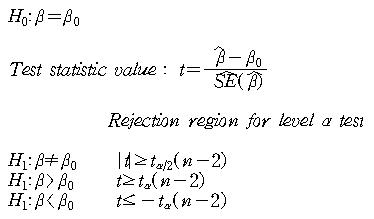
- \beta : population regression coefficient (
모회귀계수)

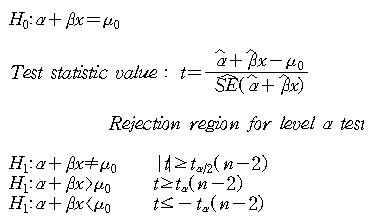
평균반응 \alpha+\beta x
에 관한 추론 
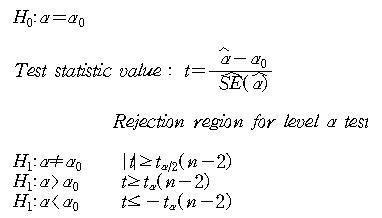
절편 \alpha에 관한 추론 
9.5 Analysis of residuals
- 표준화된 잔차인 \hat e_i,s = (y_i - \hat y_i) / \hat sigma들이 마치 표준정규분포
에서의 n개의 서로 독립인 관측값과 유사하게 나타나는가를 검토한다.
Email: lbg@kowon.dongseo.a
c.kr
|