Chap 4.
확률과 확률분포
Probability
4.1
서론
4.2
확률의 정의
- Def. Sample space S is the set of all possible outcomes of that experiment
- Def. Event is any collection(subset) of outcomes contained in the sample space
- Def.
 is called the probability of the event. is called the probability of the event.
1. For any event A, 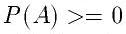
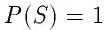
2. 
3. If  is an infinite collection of mutually exclusive events, then is an infinite collection of mutually exclusive events, then 
4.3
확률의 계산
- Def. Any ordered sequence of k objects taken from a set of n distinct object is called a permutation of size k of the objects.
- Def. Given a set of n distinct objects, any unordered subset of size k of the objects is called a combination
4.4
확률의 법칙
- Prop. For any event A and B,

- Prop. If A and B are mutually exclusive, then

- Def. For any two events A and B with
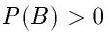 , the conditional probability of A given that B has occured is defined by , the conditional probability of A given that B has occured is defined by 
- The multiplication Rule :

- The law of total probability : Let
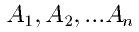 be mutually exclusive and exhaustive events. Then for any other event B, be mutually exclusive and exhaustive events. Then for any other event B, 
- Def. Two events A and B are independent if
 and are dependent otherwise. and are dependent otherwise.
- Prop. A and B are independent iff

- Def. Events
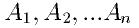 are mutually independent if for every and every subset of indices are mutually independent if for every and every subset of indices 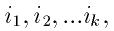

- Prop. For any event A,

4.5
확률의 법칙
Thm. Bayes' Theorem :
Let be a collection of n mutually exclusive and exhaustive events with
P(A_i)>0 for i=1,2,...n. Then for any other event B for which P(B)>0

4.6
이산확률변수
- Def. For a given sample space S of some experiment, a random variable is any rule that associates a number with each outcome in S.
- Def. Any random variable whose only possible values are 0 and 1 is called a Bernoulli random variable
- Def. A set is discrete either if it consists of a finite number of elements, or if its can be listed so that there is a first element, a second element, a third element, and so on, in the list.
- Def. A random variable is said to be discrete if its set of possible values is a discrete set.
- Def. The probability distribution or probability mass function(p.m.f.) of a discrete random variable is defined for every number x by

- Def. The cumulative distribution function(c.d.f.) F(x) of a discrete random variable X with p.m.f. P(x) is defined for every number x by

- Prop. For any two numbers a and b with a<=b,

- Def. The expected value or mean value of X, denoted by E(X) or
 ,is ,is 
- Prop. The expected value of a function
 , denoted by , denoted by ![E[h(X)]](428.jpg) or or  , is , is ![E[h(X)]=\mu_h(x)=\sum h(x)*P(x)](430.jpg)
- Prop.

- Def. The variance of X, denoted by
 or or  , is , is ![V(X)=\sum(x-\mu)^2*P(x)=E[(X-\mu)^2]](434.jpg)
- Prop.
![V(X)=E(X^2)-[E(X)]^2](435.jpg)
- Prop.

4.7
두 확률변수의 결합분포
- Def. Let X and Y be two discrete random variables defined on the sample space of an experiment. The joint probability mass function
P(x,y) is defined for each pair of numbers (x,y) by
 . .
Let A be any set consisting of pairs of (x,y) values. The the probability
![P[(X,Y) \in A] = \sum\sum_{(x,y) \in A} P(x,y)](438.jpg)
- Def. The marginal probability mass function of X and of Y, denoted by
 and and  ,
respectively, are given by ,
respectively, are given by 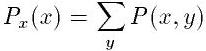 , , 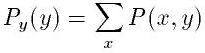
- Prop.
![E[h(X,Y)]=\sum_x \sum_y h(x,y)*P(x,y)](443.jpg) if X and Y are discrete if X and Y are discrete
- Def. The covariance between two random variables X and Y is
![Cov(X,Y)=E[(X-\mu_x)(Y-\mu_y)]](444.jpg)
- Prop.

- Def. The correlation coefficient of X and Y, denoted by
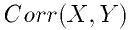 or or  is defined by \rho = Cov(X,Y) \over {\sigma_x \sigma_y}
- Prop.
1. Corr(aX+b, cY+d)=Corr(X,Y)
2. -1<=Corr(X,Y)<=1
- Prop.
1. If X and Y are independent, then \rho=0, but \rho=0 does not imply independence
2.  iff iff
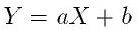 for some numbers a and b with a \ne 0 for some numbers a and b with a \ne 0
Quiz 2. Email: lbg@kowon.dongseo.ac.kr
1. If the sample space is 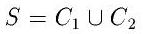 and if and if
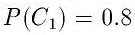 and and 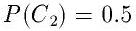 ,
find ,
find 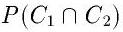 . .
2. Let the probability set function P(A) of two random variable X and Y be
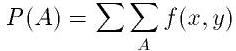 where where
 , ,
 . .
Compute P(A) when 
3. Let a fair coin be tossed at random on successive independent trials.
Find the probability that the first head appears on the third trials.
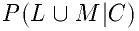
4. A study of the relationship among adult drivers between income level(L=low, M=medium, and H=high) and preference for one of the "big three" automobile manufactures(denoted by A, B, and C here) yield the accompanying table of joint probabilities.
| L | M | H | Sum |
| A | 0.10 | 0.13 | 0.02 | 0.25 |
| B | 0.20 | 0.12 | 0.08 | 0.40 |
| C | 0.10 | 0.15 | 0.10 | 0.35 |
| Sum | 0.40 | 0.40 | 0.20 | |
Use this table to compute the following conditional probabilities.
5. An executive has both a morning and an afternoon meeting on a particular day. Let A = {late to the morning meeting} and B={late to the afternoon meeting}.
a. If 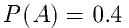 , , 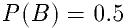 ,
and ,
and 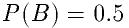 , are A and B independent events? , are A and B independent events?
b. If A and B are independent events with 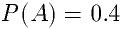 and and
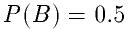 , what is the probability that the executive is on time to both meetings? , what is the probability that the executive is on time to both meetings?
6. A restaurant serves three fixed-price dinners costing $7, $9, and $10. For a randomly selected couple dining at this restaurant, let X = the cost of the man's dinner and Y = the cost of the woman's dinner. Suppose the joint
p.m.f. of X and Y is given in the following table
| P(x,y) | 7 | 9 | 10 |
| 7 | 0.05 | 0.05 | 0.10 |
| 9 | 0.05 | 0.10 | 0.35 |
| 10 | 0.00 | 0.20 | 0.10 |
a. Compute the marginal p.m.f.'s of X and Y
b. What is the probability that the man's and the woman's dinner cost at most $9 each?
c. Compute the correlation coefficient of X and Y.
d. Are X and Y independent?
e. What is the expected total cost of the dinner for the two people?
7. Incidence of rare disease. Only one in 1000 adults is afflicted with a rare disease for which a diagnostic test has been developed. The test is such that, when an individual actually has the disease, a positive result will occur 99% of the time, while an individual without the disease will show a positive test result only 2% of the time. If a randomly selected individual is tested and the result is positive, what is the probability that the individual has the disease?
[Last Update: 2001.2.20] Dongseo University Cyber Campus
|
 b.
b. c.
c.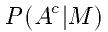
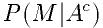 e.
e.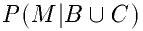 f.
f.