Chap 3.
자료의 정리(II)
3.1
서론
3.2
중심위치의 측도 (measures of central tendency)
- Population mean :

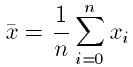
- Sample mean :
- arithematic mean :
- geometric mean :

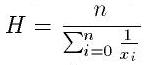
- harmonic mean :
- Sample median :

- single middle value in the ordered list if n is odd
- the average of the two middle values in the ordered list if n is even
- mode : the greatest frequency value
- Trimmed mean :

- eliminating the smallest 5% and the largest 5% of the sample
and then averaging what is left over.
3.3
산포도 (Measures of Variability)
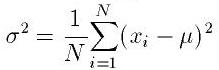
- population variance :
- population standard deviation :

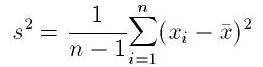
- sample variance :
- coefficient of variation :

- range :
 where, where,  :minimum value, :minimum value,  :maximum value. :maximum value.
- After the n observations in a data set are ordered from smallest to largest, the lower fourth and upper fourth are given by
 Lower quartile = median of the smallest n/2 observations Lower quartile = median of the smallest n/2 observations
 Upper quartile = median of the largest n/2 observations Upper quartile = median of the largest n/2 observations
- A measure of spread that is resident to outliers is the
interquartile range IQR , given by

3.4
상대적위치의 측도 (Measure of relative standing)
-
 percentiles percentiles
- z-score :
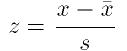
- Chebyshev's inequality :

Quiz 1. Email: lbg@kowon.dongseo.ac.kr
1. The nine measurements that follow are temperature determinations at various locations beneath the surface of Lake Ontario. 4.45, 3.91, 3.86, 3.93, 3.94, 3.90, 3.80, 3.73, 3.69
Compute :
a. The sample mean of these data values
b. The sample median of these data values
2. If the price of a commodity doubles in a period of 4 years, what is the average percentage increase per year?
3. Cities A, B, and C are equidistant from each other. A motorist travels from A to B at 30km/h, from B to C at 40km/h, and from C to A at 50km/h. Determine his average speed from the entire trip.
[Last Update: 2001.2.20] Dongseo University Cyber Campus
|