1. Development of Racing Game using Image-based Rendering
- Overview
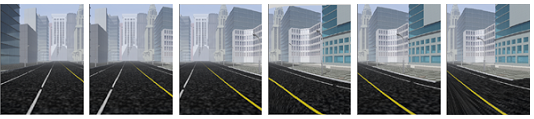
Image-based rendering for walkthroughs in the virtual environment has many advantages over the geometry-based approach because of the fast construction of the environment, photo-realistic rendered results, etc. However, light field approaches limit to the closed space so that they do not directly applicable to large and complex street environments. In this research, we present an image-based rendering method to handle a large-scale scene. It allows street walkthroughs with a light field style rendering.
- Capture Configuration for Image-Based Street Walkthroughs.
2. Extensible Interactions in X3D
- Computer Vision-assisted Interactionin X3D Virtual Environment on WWW
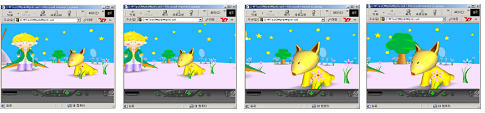
X3D is the next generation Virtual Reality Modeling Language (VRML97) using Extensible Markup Language (XML) and provides a standardized, portable, and platform-independent way to render dynamic interactive 3D scenes across the Internet. Accordingly, the current research presents the integration of a more flexible user interface into X3D using computer vision-based techniques. The proposed method enables navigation of a virtual environment on the WWW using only a USB camera and client program, without the need for a mouse or keyboard interface, specific equipment, or environmental set-up.
3. 3D Motion of Objects in an Image-based Virtual Environment
- 3D Motion of Objects in a Spherical Image-based Virtual Environment
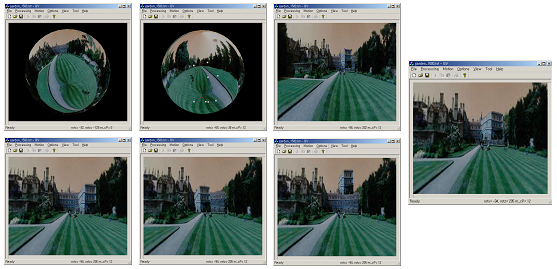
This research presents a method of enabling objects in a spherical image to have apparent 3D motion. Many researchers have solved this issue by constructing 3D model from several images using image-based modelling techniques, or building a cube modelled scene from camera calibration using vanishing points. In this research, however, we present the possibility of image-based motion without any explicit 3D information of scene geometry and camera calibration. The proposed system considers the image plane as a projective plane with respect to a view point in a virtual environment and models a 2D frame of a projected 3D object using only lines and points and a modeled frame refers to its vanishing points as local coordinates when it is transformed.
4. Image-based Motion Retargeting
- Overview
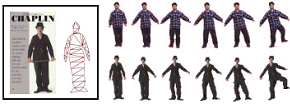
We present an automatic system for retargeting a human body extracted from an image sequence into a new character in a still image. In contrast to analysing the articulated motion of its skeleton in the previous vision-based human body tracking and posture recognition system, we use direct 2-D image warping based on a silhouette. At first, we represent the performer’s silhouette with the Delaunay Triangles Model (DTM) of which the boundary points are the critical points of the silhouette. We then use a set of affine transformations of Delaunay triangles for the human body motion, which is applied to a new character for the deformation of the subject’s DTM. The final animation of the subject is texture mapped using backward Radial Basis Functions (RBFs). Although our algorithm presented in this research is not applicable to the human body with self-occluded motion, it allows believable photo-realistic motion retargeting.
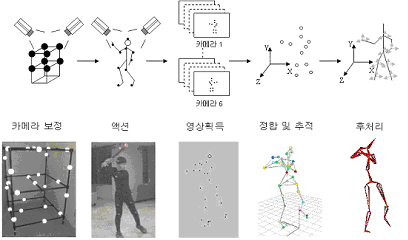
5. Development of a Low Cost Motion Capture System
- Robust multi-view correspondence of noisy 2-D points using relaxation
An efficient ghost removal algorithm for reliably extracting correspondence information for 2D points from several views using epipolar constraints is proposed. The point matching relations are modelled using a weighted k-partite graph and a globally convergent iterative algorithm is used to extract reliable maximum cliques from the graph using probabilistic relaxation labelling.
6. Project
- 1. 영상기반 렌더링 기법을 이용한 경주용 게임 엔진 개발
- Period : 2003.05 - 2004.02
- Funded by : 중소 기업청
- 2. 영상기반 가상환경 구축 기술 개발
- Period : 2000.08 - Ongoing
- Funded by : 한국 과학 재단
- 3. 저가형 광학식 모션 캡춰 시스템 및 후처리 소프트웨어 개발
- Period : 1999.3.1 - 2000.3
- Funded by : 한국 전자 통신 연구원